You closed the trade. It kept going without you. You have done that dozens of times and you still do not know what it cost.
Test your exits on trades you already took
Backtesting takes the trades you have reviewed and works out what a different exit would have paid. A fixed target, or moving your stop to breakeven once the trade has run a set distance your way. It runs on your own record, so it needs no market data and no key.
Questions you cannot answer by trading more
These are the ordinary things you wonder about after a session. The usual way to find out is to take another hundred trades and hope you notice.
Taking profit early
You bank it at 1R because the last one gave it all back. Nobody has ever scored those two habits against each other over your own trades.
Moving the stop to breakeven
It rescues some trades and it takes you out of winners. Which way that nets out is a number. You do not have it.
How many trades a figure is built on
A rule that looked good over nine trades is a coincidence, and an average on its own will not tell you which one you are looking at.
It runs on what you already wrote down
Your review holds where you got in and where you got out. Two more boxes ask for the best and the worst price the trade reached while you were in. Fill those in and an exit rule can be priced against the stop you wrote in your plan. Leave them blank and that trade is counted but never priced.
Six rules at once
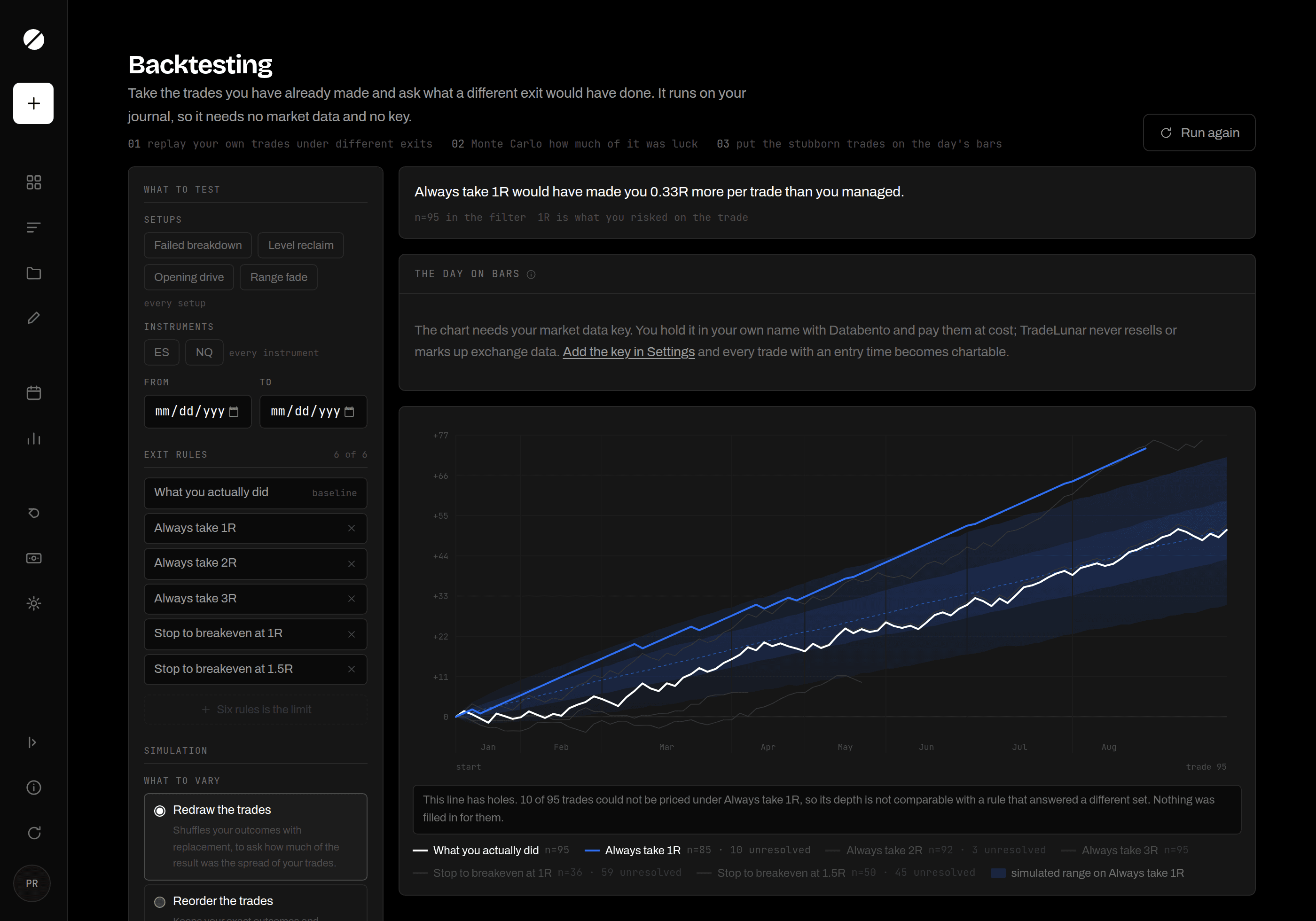
What you actually did, a fixed target at 1R, 2R or 3R, and a stop to breakeven at 1R or 1.5R. The first one stays put, because it is the line the other five are measured against. Swap those five for the levels you trade. R means multiples of what you risked on that trade.
The finding, in one sentence
The top of the page says what the study found in plain words, with the number of trades behind it printed alongside. The table underneath shows how it got there.
Thin samples are labelled thin
Under thirty trades the page calls the result a hint to watch, not a rule to change. The count sits beside every figure, never in a footnote.
The trades it cannot answer
Some trades cannot be priced under a rule, and the page says so instead of guessing. Your stop and your target both traded, and the journal keeps the two extremes but not the order they came in. Or price traded back through your entry and nothing on file says whether that was before or after the high. Or the best and worst prices were never filled in. Those trades are counted, printed next to the rule they belong to, and left out of its average. A rule that could only price a small share of them is not ranked against the rest at all, because a rule that skips the hard trades looks best by skipping them.
The part that needs price data
Settling one of those trades takes the price bars from that day, read in order. That is not built yet. When it ships you will buy the bars yourself, from Databento, in your own name, at their price. We never resell or mark up exchange data, so there are no credits to buy and nothing to run out of.
- The Databento account is in your name, not ours
- You pay Databento directly, at their price
- Backtesting on your own journal never needs it